Why Custom Cash Flow Risk Scores Trump Standardized Scores
Keep seeing this prediction in my feed: every major lender/fintech will eventually have its own cash flow risk score.
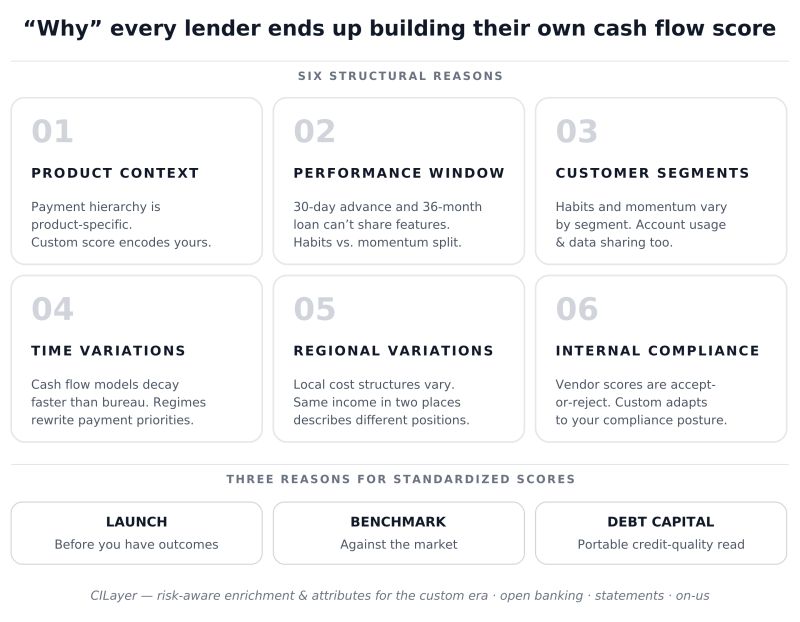
Keep seeing this prediction in my feed: every major lender/fintech will eventually have its own cash flow risk score. It’s correct, but not really new. Most banks have run on custom bureau-data scorecards for decades; standardized scores live at the edges, not the core. Cash flow is heading to the same equilibrium, just faster.
What’s missing from the discussion is the why. I see six structural reasons for this (would love additional thoughts):
- Product Context Impact: Past behavior on a product is often the best predictor of future behavior on it: rent, bnpl, advances, autos, NSFs. Cash flow extends this to products a lot more than what bureaus covered Why: Key reason is Payment Hierarchy. A $2,000 rent payment, a $500 personal loan, and a $100 BNPL installment don’t sit in the same slot in a consumer’s head. A standardized score doesn’t pick ordering, whereas a custom score encodes the one that matches your product
- Performance Window Impact: A 30-day advance and a 36-month installment loan can’t share the same feature set. One score can’t serve both Why: Long performance windows surface good money habits which are structural; shorter window picks up momentum (recent patterns). More on these factor types later
- Customer Segments Impact: Momentum (recent patterns) factors are often found useful for bad/no/thin file customers. Good money habits also mean different things across segments, and different set of factors are relevant Why: This is often acknowledged & known. Additionally, account usage (concentrating vs spreading between accounts) & data sharing (freely vs less sharing) behavior also matters
- Time Variations Impact: Cash flow models decay faster than bureau models Why: Regimes rewrite customer priorities & payment hierarchies. New merchant categories emerge & fade. Self-learning enrichment isn’t optional & risk scores need to be adaptive
- Regional Variations Impact: Standardized scores systematically misapply to local cost structures. For a regionally tilted applicant pool, a custom model captures these variations better Why: Average rental housing burden can be vastly different based on location. Same income in two geographies can describe different financial positions
- Internal Compliance Impact: A vendor score is either an accept or reject for internal compliance. A custom model gets shaped to the framework as it evolves. Why: Compliance for cash flow attributes & scores are still evolving. Owning the model means moving with your compliance team’s thinking, posture & requirements.
Standardized scores still matter for 3 key requirements:
- Launching before you have meaningful outcomes
- Benchmarking against the market
- Better credit-quality read for debt partners
Outside of these key requirements - the equilibrium will always be custom.
Through CILayer we’re building risk-aware enrichment, attributes & tools to cater to this demand. Applicable across open banking, bank statements, and on-us data.
#CILayer
Originally posted on LinkedIn.
See reasoning trails on your own decisions
A working session with the team building CILayer, consumer or commercial.