Cash Flow Underwriting: Momentum vs Habits
Cash flow underwriting isn't just about applying credit scores — it's about the underlying factors that drive risk.
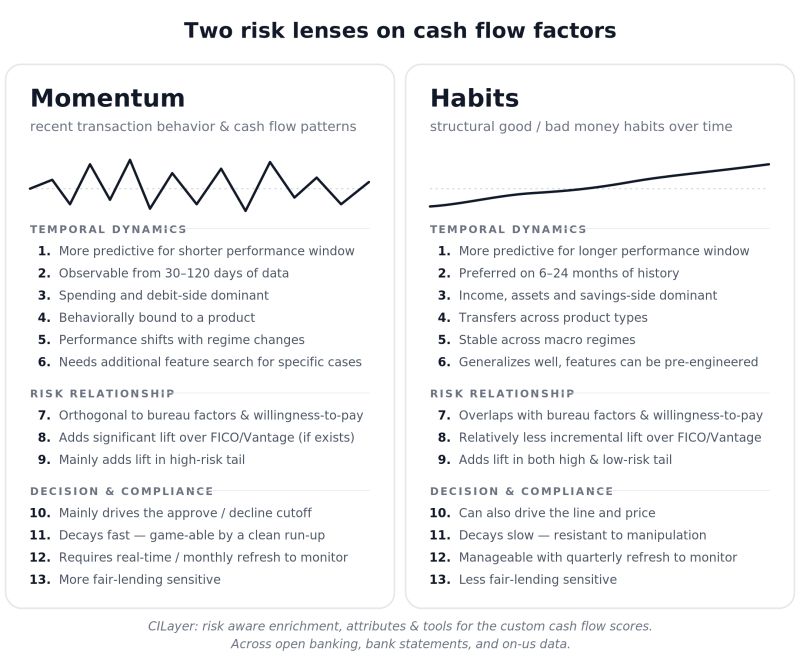
Cash flow underwriting isn’t just about applying credit scores — it’s about the underlying factors that drive risk. For lenders, it boils down to two: Momentum and Habits. Mastering the distinction is key to better modeling.
Momentum: recent transaction behavior & cash flow patterns. “How is the consumer doing right now?” — predicting near-term cash flow. Habits: structural good/bad money habits. “How has the consumer been doing over time?” — predicting resiliency.
Its often known/quoted that: Momentum carries higher marginal value on no-file, thin-file & bad-credit (bureau signal weak). Habits matter more on thick-file, near-prime & prime (structural signal exists). But the real picture is more nuanced.
Temporal Dynamics
- Momentum: needs 30-120 days history, predicts over shorter windows. Habits: needs 6-24 months, predicts over longer windows.
- Habits generalize; pre-engineered features work across products & use cases. Momentum is product/use-case-specific; needs feature discovery.
- Momentum relies on spending/debit-side, shifts with regime. Habits rely on assets, savings & debit-side; stable across regimes.
Risk Relationship
- Momentum is orthogonal to bureau willingness-to-pay; adds significant lift over FICO/Vantage. Habits overlap; less incremental.
- Momentum mainly lifts the high-risk tail; habits lift both tails.
Decision & Compliance
- Momentum drives approve/decline; habits can also drive line & price.
- Momentum decays fast, game-able — needs real-time/monthly refresh. Habits decay slow, resist manipulation — quarterly refresh works.
- Momentum is more fair-lending sensitive (categories can proxy class); habits less so.
Note: these dynamics aren’t strict. Habits-style features can be short-term, momentum-style can be long-term. The right representation varies by product, window & use case.
Operating rules (imo):
For longer performance window:
- Focus on incremental lift; evaluate vs off-us data friction
- Leverage on-us data first for existing depository customers
- Compliance: start with habits, iterate to include momentum
- Habits work with simple attributes; well-curated features still bring better lift
- Test habits features in line & price models
- Quarterly monitoring
For shorter performance window:
- Product-specific scores, or build custom score on own applicants
- Well-curated momentum features preferred
- Search/discover new patterns for the specific objective (more on ways to do this later)
- Real-time or monthly monitoring
Most scores use both, but its useful to keep these factors in mind when evaluating features/scores for your specific problem.
#CreditRisk #CashFlowUnderwriting #CILayer #Fintech #Lending
Originally posted on LinkedIn.
See reasoning trails on your own decisions
A working session with the team building CILayer, consumer or commercial.